Video evidence - Reform specific parts
Tonya L. Brito
Professor, University of Wisconsin Law School
Video: Access to Justice in Family Court | University Place
PBS Wisconsin "University Place" broadcast of a UW-Madison "Wednesday Nite @ the Lab" lecture, "Access to Justice in Family Court", 2022-02-04(upload date; the recording date is not stated)
Tonya L. Brito
PBS Wisconsin "University Place" broadcast of a UW-Madison "Wednesday Nite @ the Lab" lecture, "Access to Justice in Family Court" - 2022-02-04
Nothing loads from YouTube until you press Play. The player then uses YouTube's privacy-enhanced mode (youtube-nocookie.com).
What is said at 14:19
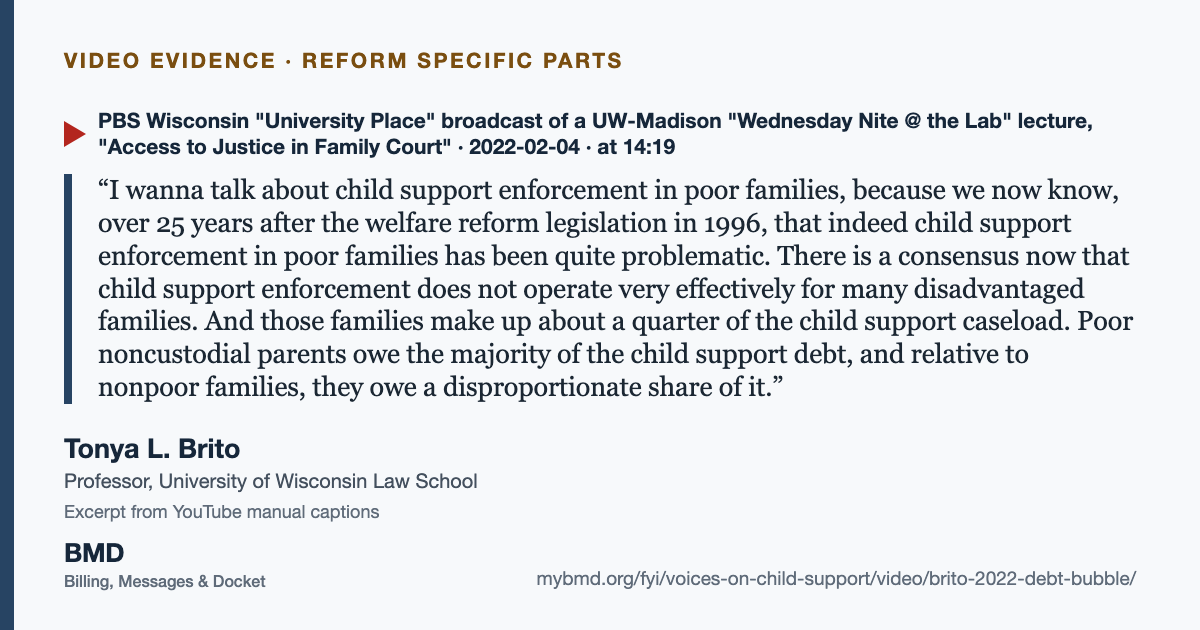
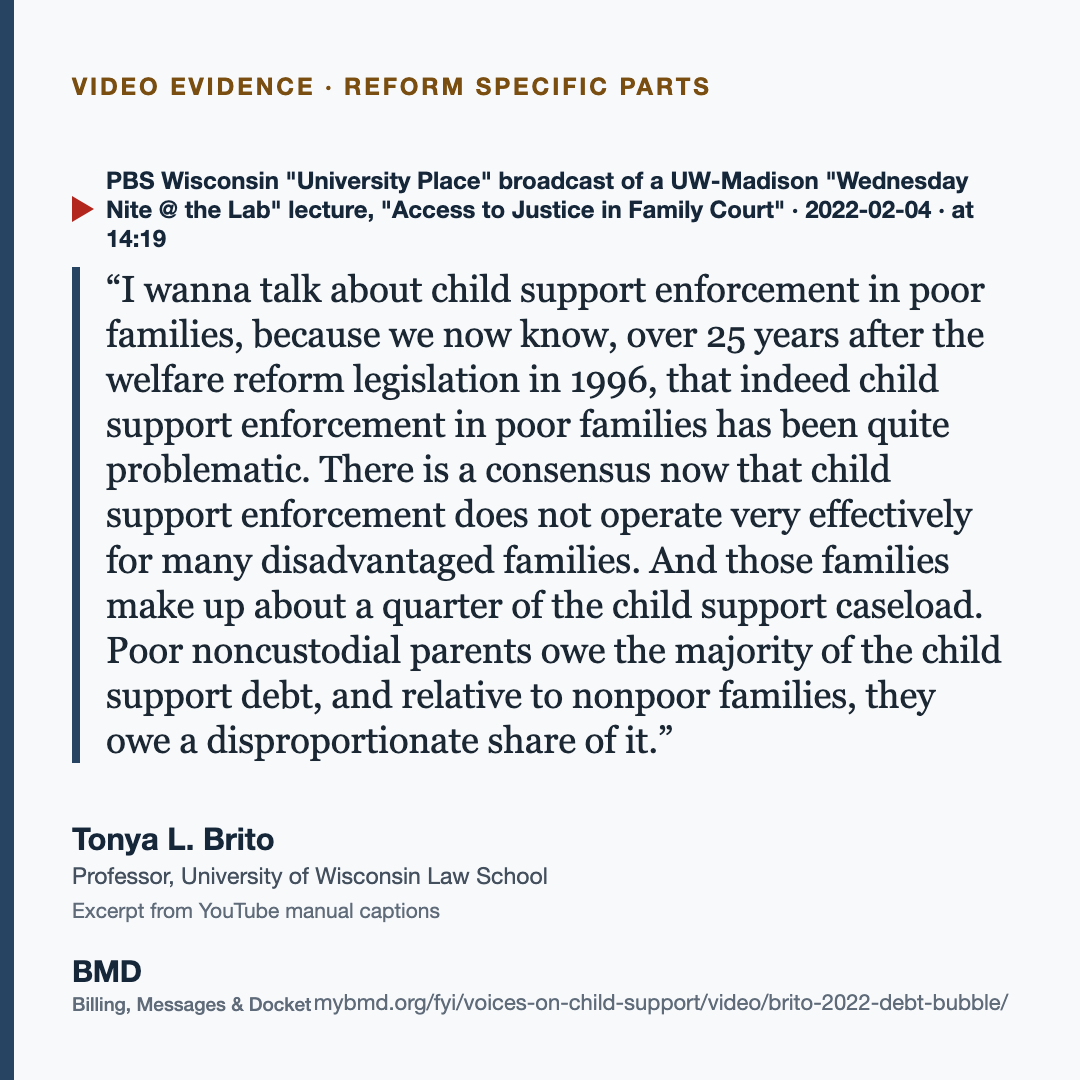
"I wanna talk about child support enforcement in poor families, because we now know, over 25 years after the welfare reform legislation in 1996, that indeed child support enforcement in poor families has been quite problematic. There is a consensus now that child support enforcement does not operate very effectively for many disadvantaged families. And those families make up about a quarter of the child support caseload. Poor noncustodial parents owe the majority of the child support debt, and relative to nonpoor families, they owe a disproportionate share of it."
Excerpt source: YouTube manual captions. Checked 2026-10-13.
What they argue
Legal researcher documents how 1980s-90s enforcement reforms that work for steady earners leave poor families with unpaid support and large child support debt (her paper "The Child Support Debt Bubble"); diagnostic critique rather than a specific reform proposal.
Position label: Reform specific parts. It describes this clip only, and "abolish" is used only when the speaker says it.
Share
Share images: landscape, 1200 x 630 · square, 1080 x 1080.